Wednesday, November 26, 2008

Politics in Japan


Today is Wednesday. Garbage day. In Hirakata City, trash must be sorted into 5 different categories. Although this can be a pain, it isn't too bad once you understand the system. The rule book that I received when I moved into SemIV went as far to provide two photos to assist residents with sorting.
The sorting mania has been in part inspired by environmental issues and by also by the mentality of "waste not, want not".
Japan is a country where space is a precious commodity; there is no room for foolishness here, especially in the landfills.
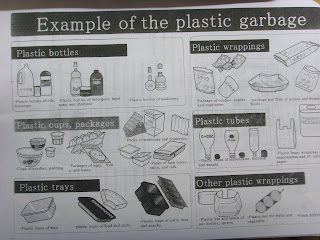


Then there is the other side of the coin. Many fruits in the supermarket are wrapped in a foam mesh, surrounded by a cardboard carton and then wrapped in cellophane. This is then placed inside of another bag once it is purchased. In case of rain, the external bag is covered by a plastic cover. However, I wonder why some of these issues can't be eliminated by reducing the amount of excessive packaging in Japan.


Wednesday, November 19, 2008

Religion in Japan

One day, I went to a shrine with my friend Kieko; it was located in her hometown. Almost immediately she climbed the stairs to complete the ritual of ringing the bell, tossing a coin, clapping twice, saying a prayer and bowing twice. I asked her to explain it to me and she told me that the noises call the attention of the gods to her prayer. As I asked her more questions about her religion, she couldn't really answer me. For example, we all waited outside the shrine for an hour while the elders went inside. I asked her what they were doing but she wasn't sure.


It seemed that most of the people weren't there for religious reasons only, it was a place where one could meet the neighbors. The shrine appeared to be more of a gathering place for the community, a type of glue that held generations together through one common bond.

Wednesday, November 12, 2008

Gender in Japan

Is this a photo of an ideal Japanese woman? Ready and waiting to serve? Traditionally, women were were taught to be reserved, subservient and obey the dominant male in their life (either the father or the husband.)


Some would say that this makes the Japanese culture chauvinistic. I disagree. Until this day, women have played a very large and important part of Japanese history and culture. For example, it was a woman, Murasaki Shikibu, who wrote the world's first novel entitled, "The Tale of Genji". This year is actually the 1000th year anniversary of this infamous book. This is a memorial dedicated to her that is located in Uji.


When I speaking with my Okaasan about Murasaki Shikibu, she told me that "Japanese women are strong." She told me that many Japanese women want to have a career and do not get married until mid to late 20's. They are very driven; Osaka even boasted Fusai Ohta, the first governor of Japan. As you can see, the woman's gender role is very important in Japan.

Wednesday, November 5, 2008

Sports in Japan

Aikido
The Way of the Harmonious Spirit

Aikido is a Japanese martial art. The defendant redirects the attacker's momentum through throws and grappling all in such a way as to keep the aggressor safe from harm. It uses minimal movement and energy from the defendant. This art form also teaches mental training. Students learn to relax both the mind and body under stressful situations.


Training in Japan is very rigorous as compared to America. When I took Tai Quan Do in high school, I practiced for about an hour a day. In comparison, my one friend joined the Aikido club at Kansai Gadai. She puts in about 4-6 hours on a normal day. When they are preparing for a demonstration, like they were doing last week for the Festival, they put in about 12 hours each day.

Wednesday, October 22, 2008

Globalization: The Japanese Version of Walt Disney

Recently, I went to Tokyo to see some DJ's perform. On the way to Chiba, about 80% of the people coming off of the trains were carrying Walt Disney paraphernalia in brightly colored plastic bags. A sure sign that one has been to Disney World.
Once I reached the venue, I was surprised and delighted to see that one of the leading acts had incorporated Disney clips into their screen show.

Fantasia at it's best.


Most of my Japanese friends have been to Disney World; it seems that a trip to Tokyo is just not complete without going to this theme park. Never mind that most of them are in their late teens to early 20s, they all rave about it. In fact, my home visit partner traveled to Tokyo in September and of course he visited Disney. He brought me back a whole bag filled with Mickey-shaped goodies including these yummy butter cookies!

These cartoons that were created for runny-nosed American children has traveled across the Pacific Ocean to Japan. Who can resist Mickey Mouse?

Wednesday, October 15, 2008

Traditional Japanese Culture

This past weekend my Japanese friend, Kieko, invited me to her hometown for her annual fall festival. It was a religious holiday that spanned three days. It was very important to the Yamamoto family. When I asked what each of their hobbies were the response was, "Calligraphy, piano and Fall Festival."
Everyone was dressed in traditional garb. Mrs. Yamamoto even gave us coats called Happi to wear! Each Happi was decorated with the community's emblem and colors. Here is Kieko and the back of her community's happi, mixing technology with tradition.


Festival-goers would pull an ornately decorated cart called a Yatai through the neighborhood. There were people on the Yatai playing traditional music called Tokeigaku and still others chanting "EE-SHO-NEE!" (Something similar to our 'heave, ho!') Each community had one and we would occasionally run into another while we were parading through the streets. We would then stop for a while and then continue on. (Where's Waldo?)


It was a very lively time with lots of eating, drinking, song and dance. It was a festival steeped in Japanese traditions. If you would like to experience a festival like this one, there are a list of dates here. (Page down to October 15th).

Tuesday, October 7, 2008

Japanese Pop Culture

If pop culture was chewing gum for the mind, the Japanese version would be Willy Wonka's "three-course meal" blueberry flavor; an eclectic mix of tastes and subject that covers just about anything imaginable.
Pop culture covers a range of subjects from the media to art and also celebrities. They are usually well know, generally accepted and widespread within a certain population.


This is purikura; it is very popular in Japan. It is an enclosed booth where friends can take silly photos with their friends. Patrons are usually middle school-aged girls and the occasional group after a round of late night karaoke.

Part of popular culture in Japan to take photos of anything and everything.
Photography "especially appeals to people handicapped by a ruthless work ethic - Germans, Japanese, and Americans. Using a camera appeases the anxiety...about not working when they are...supposed to be having fun. They have something to do that is an...imitation of work: taking pictures." - Plato's Cave by Susan Sontag